
Tag: Yonguk Lee

Yonguk Lee publishes paper on how HeRX behavior is affected by varying strain and temperature
February 26, 2026Yonguk Lee published “Heteroepitaxial recrystallization under steep strain and temperature gradients” in Superalloy 718 and Derivatives. This paper addresses the HeRX behavior at varying processing conditions, discussing HeRX’s potential role for the abnormally large grain formation at strain limited condition, and competition between HeRX nucleation and annealing twin nucleation at primary γ’ particles at varying […]
Read more: Yonguk Lee publishes paper on how HeRX behavior is affected by varying strain and temperature »
Yonguk Lee publishes paper on microstructural evolution of AM Ni-based superalloys
August 22, 2025Yonguk Lee published “Unraveling the impact of pressure and hold time in post-process heat treatments on microstructure and microhardness evolution in laser powder bed fusion Alloy 718” in Progress in Additive Manufacturing. This collaborative work with the Illinois Institute of Technology reports the accelerated recrystallization of LPBF Alloy 718 during the HIP process, suggesting that […]
Read more: Yonguk Lee publishes paper on microstructural evolution of AM Ni-based superalloys »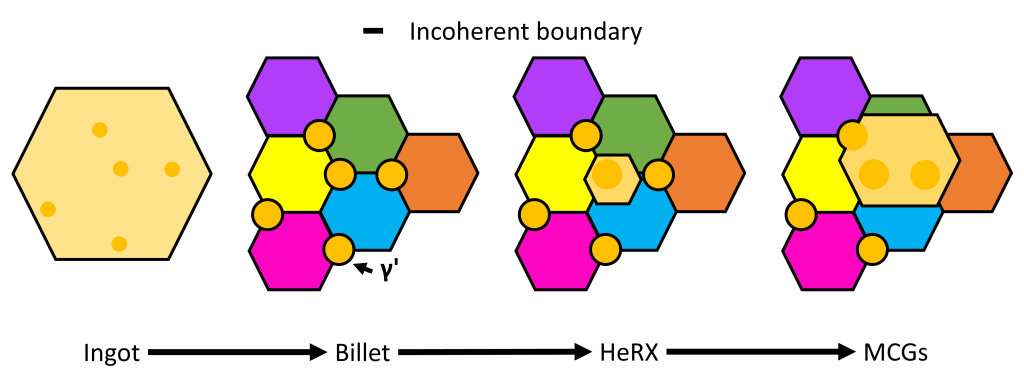
Yonguk Lee publishes paper describing multiply coherent gamma grains in a Ni-base superalloy
August 21, 2024Yonguk Lee recently published “On the Formation of Multiply Coherent γ Grains in a Powder Metallurgy Ni Base Superalloy” in the Superalloys 2024 proceedings. The paper reports a unique γ microstructure which contains multiple pinning particles inside that are coherent (multiply coherent gamma grains, MCGs), which are explained to have possibly formed through the combined effect of initial orientation […]
Read more: Yonguk Lee publishes paper describing multiply coherent gamma grains in a Ni-base superalloy »![HAADF-STEM images of the LHSR alloy. a Low magnification image showing multiple primary γ′ particles. b Magnified image of the red dashed box in (a) that shows round, darker areas on the right side of the image, indicative of tertiary γ′ precipitates. c Magnified image of the dashed orange box in (b) highlighting the coherent γ-γ′ interface. d High magnification HAADF-STEM image along the [112] zone axis from (c) marked by the blue dashed box, showing the atomic structure of the L12 γ′ LHSR alloy.](https://faculty.eng.ufl.edu/miller-mse/wp-content/uploads/sites/236/2024/08/13_modified-1024x937.png)
Yonguk Lee publishes paper describing the prevalence of HeRX in LSHR
January 23, 2024Yonguk Lee recently published “Prevalence of Heteroepitaxial Recrystallization in the Low Solvus High Refractory (LSHR) γ–γ′ Superalloy” in Metallography, Microstructure, and Analysis. The paper reports the observation of HeRX outside of low-misfit Ni-base superalloys for the first time, which suggests that HeRX can contribute to microstructural evolution in a much wider range of polycrystalline Ni-base […]
Read more: Yonguk Lee publishes paper describing the prevalence of HeRX in LSHR »Yonguk Lee passes qualifying exam!
May 1, 2023Yonguk (Tony) Lee passed his qualifying exam, with his proposal entitled “Heteroepitaxial recrystallization in Ni-based superalloys: its nucleation and boundary character.” Congrats Tony!
Read more: Yonguk Lee passes qualifying exam! »