
Category: News
Things that are happening in the MONSTER group

MONSTER Group attends TMS 2025 in Las Vegas
March 28, 2025The MONSTER group headed to Las Vegas, NV for TMS 2025, where there was so much to see and do! Every group member gave at least one oral talk, and we also attended workshops and networking events while checking out touristy Vegas sites such as the Sphere, the Bellagio Fountain, and Meow Wolf. The MONSTER group had […]
Read more: MONSTER Group attends TMS 2025 in Las Vegas »
MONSTER Group Tries Blacksmithing!
February 28, 2025What happens when you let metallurgists out of the lab? They don’t touch grass, they instead find their way back to metal, of course! After taking a few blacksmithing classes herself, Tori organized a MONSTER group blacksmithing adventure for her grad students with the help of Leslie Tharp at Fever Metal Art Center here in […]
Read more: MONSTER Group Tries Blacksmithing! »Megan Hurley publishes paper on how magnetic fields affect microstructural evolution of steel microstructures
February 26, 2025Megan Hurley has published her first paper entitled “Microstructural Evolution of Steel during Magnetic Field Assisted Processing” in a JOM special issue for diffusionless phase transformations in engineering alloys. This paper discusses how applying varied magnetic field strengths during thermal processing impacts the formation and growth of austenite, martensite, and pearlite microstructures in a near-eutectoid […]
Read more: Megan Hurley publishes paper on how magnetic fields affect microstructural evolution of steel microstructures »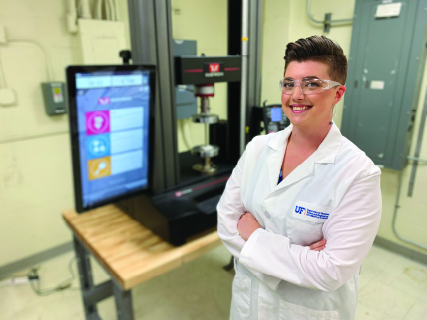
Dr. Tori Miller Awarded the Vladimir A. Grodsky Professorship
February 18, 2025The MONSTER Research Group is thrilled to announce that Dr. Tori Miller has been awarded the Vladimir A. Grodsky Professorship in the Materials Science & Engineering Department at UF! This prestigious recognition honors Dr. Miller’s sustained performance and excellence in research, teaching, and service in materials science & engineering with a specialization in metals. Congratulations, Dr. […]
Read more: Dr. Tori Miller Awarded the Vladimir A. Grodsky Professorship »
Tianchen Wei publishes paper on the relationship between initial microstructure, laser bending behavior, and resultant microstructure
February 13, 2025Tianchen Wei published his first paper “Laser Bending Behavior of Austenitic Stainless Steels and Characterization of the Resultant Microstructures” in the Journal of Materials Engineering and Performance. This study establishes a correlation between the initial microstructure of the material and the resulting bending angles achieved through laser sheet metal forming. It further elucidates the microstructural […]
Read more: Tianchen Wei publishes paper on the relationship between initial microstructure, laser bending behavior, and resultant microstructure »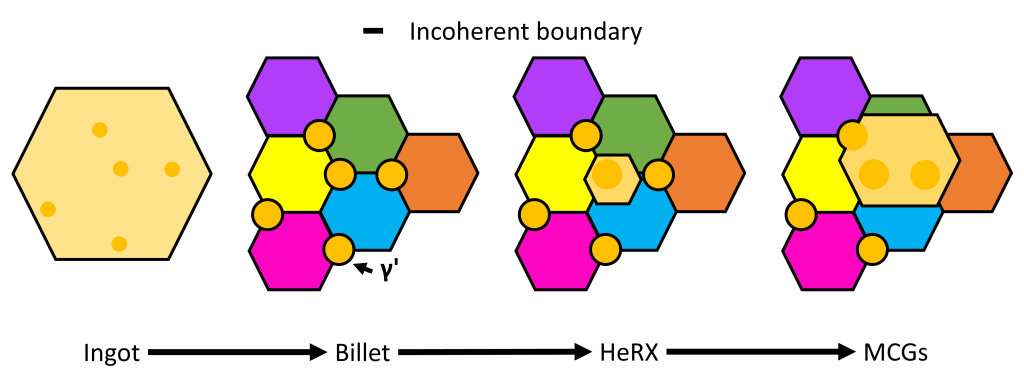
Yonguk Lee publishes paper describing multiply coherent gamma grains in a Ni-base superalloy
August 21, 2024Yonguk Lee recently published “On the Formation of Multiply Coherent γ Grains in a Powder Metallurgy Ni Base Superalloy” in the Superalloys 2024 proceedings. The paper reports a unique γ microstructure which contains multiple pinning particles inside that are coherent (multiply coherent gamma grains, MCGs), which are explained to have possibly formed through the combined effect of initial orientation […]
Read more: Yonguk Lee publishes paper describing multiply coherent gamma grains in a Ni-base superalloy »Nathan Fripp passes qualifying exam!
May 10, 2024Nathan Fripp passed his qualifying exam, with his proposal entitled “Enhanced Control of Laser Forming Outcomes Through Tailored Thermal Gradients.” Congrats Nathan!
Read more: Nathan Fripp passes qualifying exam! »
MONSTER Group attends TMS 2024 in Orlando
March 8, 2024This year the MONSTER group ventured an impressive two hours south from Gainesville, FL to Orlando, FL for TMS 2024, with a couple of newbies filling the passenger seats. Kimi, June, and Nathan eased in by presenting posters on their work, while the veterans (Ben, Begley, Tony, and Megan) delivered oral presentations. Though we might be […]
Read more: MONSTER Group attends TMS 2024 in Orlando »![HAADF-STEM images of the LHSR alloy. a Low magnification image showing multiple primary γ′ particles. b Magnified image of the red dashed box in (a) that shows round, darker areas on the right side of the image, indicative of tertiary γ′ precipitates. c Magnified image of the dashed orange box in (b) highlighting the coherent γ-γ′ interface. d High magnification HAADF-STEM image along the [112] zone axis from (c) marked by the blue dashed box, showing the atomic structure of the L12 γ′ LHSR alloy.](https://faculty.eng.ufl.edu/miller-mse/wp-content/uploads/sites/236/2024/08/13_modified-1024x937.png)
Yonguk Lee publishes paper describing the prevalence of HeRX in LSHR
January 23, 2024Yonguk Lee recently published “Prevalence of Heteroepitaxial Recrystallization in the Low Solvus High Refractory (LSHR) γ–γ′ Superalloy” in Metallography, Microstructure, and Analysis. The paper reports the observation of HeRX outside of low-misfit Ni-base superalloys for the first time, which suggests that HeRX can contribute to microstructural evolution in a much wider range of polycrystalline Ni-base […]
Read more: Yonguk Lee publishes paper describing the prevalence of HeRX in LSHR »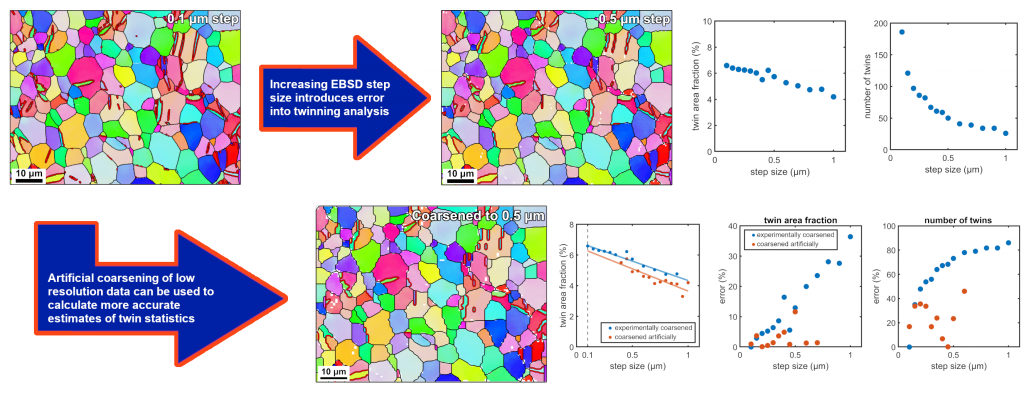
Benjamin Anthony publishes paper quantifying the effects of EBSD step size choices
December 11, 2023Benjamin Anthony recently published “A ‘step’ in the right direction: quantifying error in twinning analysis due to EBSD scan resolution” in Scripta Materialia. This paper demonstrates the error in calculated twin fraction and other features when using too-large EBSD step sizes. Read the paper here: https://doi.org/10.1016/j.scriptamat.2023.115929
Read more: Benjamin Anthony publishes paper quantifying the effects of EBSD step size choices »